About 394 minutes
The Treasure-Train — Story, Setting & Ideas
Technology Airships Imagined Futures
90,616 recorded words. 48 minutes difference from this book's estimate.
View Gutenberg source #5087
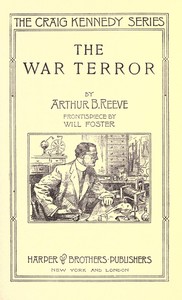
The source record for The War Terror — Context and Discussion measures this digital text at 101,532 words, 7 hr 22 min estimated reading time, and 39 detected text sections.
The text analysis averages about 14.9 words per sentence, while the detected sections provide another way to judge how the source is divided.
Project Gutenberg metadata also associates the work with “New York (N.Y.) -- Fiction,” connecting these edition facts with the source record’s subject description.
Explore this collection
These alternatives are selected using recorded categories and estimated reading time.
About 394 minutes
Technology Airships Imagined Futures
90,616 recorded words. 48 minutes difference from this book's estimate.
View Gutenberg source #5087About 394 minutes
Technology Airships Imagined Futures
90,395 recorded words. 48 minutes difference from this book's estimate.
View Gutenberg source #9081About 315 minutes
Technology Airships Imagined Futures
72,356 recorded words. 127 minutes difference from this book's estimate.
View Gutenberg source #8295Search stored excerpts and compare books → Choose by your preferences →
Choices use stored catalog measurements. Estimates vary with reading speed. A shared category is a catalog label, not a claim that two books have the same argument or literary quality.
Search reads excerpt text stored with this catalog and links to its associated Gutenberg record. The connection is stored in the site database; this tool does not recheck that every excerpt is word-for-word identical to that external record. Excerpt search does not cover every chapter and does not verify historical publication dates.
Catalog snapshot checked: 2026-09-25. Coverage: 95 public books, 95 available source excerpts.
Read the complete public-domain text at its original source.
Read on Project GutenbergArthur B. Reeve's The War Terror (1917) presents Craig Kennedy, a chemistry professor who applies nascent forensic techniques to a series of linked crimes. The narrative moves briskly from a curio shop to a Riverside Drive mansion, with each chapter introducing a new scientific gadget—from an electro-magnetic gun to a lie detector. The opening pages establish a pattern: Kennedy is summoned urgently, a clue is examined under a microscope or with chemical paper, and the scene shifts abruptly as a new suspect or device appears. The story's structure mirrors the episodic serial format, with each chapter functioning as a self-contained puzzle that nonetheless contributes to an overarching web of wartime espionage.
Throughout the excerpts, Kennedy relies on physical evidence that leaves a mark: a forehead print on chemical paper, a paste replica of jewels, a germ-laden letter. These objects are described with clinical precision—the 'chemical paper,' the 'wicker table,' the 'plain gold bracelet' on a nurse's forearm. The narrative lingers on the materiality of clues, often contrasting the mundane setting (a sun parlor, a curio shop) with the exotic threat (a 'pillar of death,' a 'happy dust'). This tension between the ordinary and the sinister is a hallmark of the series, and Reeve uses it to ground his scientific marvels in recognizable New York interiors.
The story progresses through rapid, almost cinematic scene changes. A single paragraph might begin with a shout at a street door, then cut to a cab arriving, then to a safe being opened. The narrator, Walter Jameson, often notes that events were 'so confused' he cannot follow them, emphasizing the speed of action. This technique creates a sense of urgency and mirrors the wartime atmosphere of the book's setting. The chapters are linked by Kennedy's restless movement: from the Blake mansion to a curio shop, from a houseboat to a laboratory. Each new location introduces a fresh set of characters and a new technological puzzle, but the underlying thread of espionage keeps the episodes connected.
The story is told by Jameson, a journalist who chronicles Kennedy's cases. His voice is observant but often bewildered, providing a layman's perspective on the science. He describes a nurse's 'full, plump forearm' and a suspect's 'scornful curl of the lip,' adding a human dimension to the technical proceedings. The dialogue is clipped and dramatic, with characters often interrupting each other ('Quick!', 'You lie!'). This style reinforces the sense of crisis. Jameson's narration also includes retrospective commentary, as in the introduction, where he frames the events as part of a larger 'spy system' that 'ramified tentacle-like' across the ocean.
The book is composed of 36 chapters, each titled with a scientific or sensational phrase ('The Electro-Magnetic Gun,' 'The Germ Letter,' 'The Lie Detector'). The introduction suggests that these episodes were originally published separately, and the narrative retains a serial structure: each chapter introduces a new mystery, resolves it by the end, and then hints at the next. The overarching plot—wartime espionage in neutral America—is established early but recedes in many chapters, which focus on domestic crimes like blackmail and jewel theft. This episodic design allows readers to enter at any point, but the cumulative effect is a portrait of a society under the 'war terror,' where even a Riverside Drive mansion can harbor a spy.
Readers should approach The War Terror as a series of linked vignettes rather than a single novel. Pay attention to the recurring use of chemical tests and mechanical devices, which serve as both plot devices and period markers. The rapid scene changes and clipped dialogue reward close reading, while the narrator's occasional confusion invites the reader to piece together clues alongside Kennedy. The book offers a window into early 20th-century anxieties about technology and espionage, filtered through the lens of a popular detective series.
I keep thinking about how Craig Kennedy’s hidden identities echo that old story of two wanderers in a foreign land, pretending to be kings. There’s a loneliness in both—wearing a mask so long you forget the face beneath. It reminds me of a quiet evening years ago, turning pages by lamplight, feeling that same ache of invented selves. The Man Who Would Be King — Inside the Classic stays with me that way, like a faint streetlamp through fog.
Save your reaction, strongest insight, and memorable passage.