About 394 minutes
The Bacillus of Beauty: A Romance of To-day — Background and Themes
Technology Airships Imagined Futures
90,395 recorded words. 0 minutes difference from this book's estimate.
View Gutenberg source #9081
For The Treasure-Train — Story, Setting & Ideas, the stored edition analysis reports 90,616 words, 6 hr 34 min estimated reading time, and 9 detected text sections.
The text analysis averages about 14.7 words per sentence, while the detected sections provide another way to judge how the source is divided.
Project Gutenberg metadata also associates the work with “New York (N.Y.) -- Fiction,” connecting these edition facts with the source record’s subject description.
Explore this collection
These alternatives are selected using recorded categories and estimated reading time.
About 394 minutes
Technology Airships Imagined Futures
90,395 recorded words. 0 minutes difference from this book's estimate.
View Gutenberg source #9081About 442 minutes
Technology Airships Imagined Futures
101,532 recorded words. 48 minutes difference from this book's estimate.
View Gutenberg source #5073About 315 minutes
Technology Airships Imagined Futures
72,356 recorded words. 79 minutes difference from this book's estimate.
View Gutenberg source #8295Search stored excerpts and compare books → Choose by your preferences →
Choices use stored catalog measurements. Estimates vary with reading speed. A shared category is a catalog label, not a claim that two books have the same argument or literary quality.
Search reads excerpt text stored with this catalog and links to its associated Gutenberg record. The connection is stored in the site database; this tool does not recheck that every excerpt is word-for-word identical to that external record. Excerpt search does not cover every chapter and does not verify historical publication dates.
Catalog snapshot checked: 2026-09-25. Coverage: 95 public books, 95 available source excerpts.
Read the complete public-domain text at its original source.
Read on Project GutenbergArthur B. Reeve's The Treasure-Train opens not with a train but with a laboratory, where Professor Craig Kennedy is consulted by Maude Euston, daughter of a railway president. She has overheard a suspicious conversation in a hotel tea-room, linking her father's company to unnamed 'warring powers.' The novel's first chapter establishes a pattern: crime is introduced through overheard whispers and newspaper reports, and Kennedy's scientific methods are invoked before any physical evidence appears. The catalog subjects list 'Chemistry teachers -- Fiction' and 'Kennedy, Craig (Fictitious character) -- Fiction,' yet the excerpts show Kennedy functioning less as a teacher than as a consulting detective who deploys gadgets and psychological insight. The setting is firmly New York, but the plot's international dimensions—gold shipments from Halifax, foreign agents—suggest a wider geopolitical stage that the excerpts only hint at.
The excerpts repeatedly place Kennedy in his laboratory, yet the actual investigative work occurs elsewhere. In Chapter I, Kennedy listens to Maude Euston in his lab, then immediately reads a newspaper account of a mysterious illness. The lab functions as a narrative hub rather than a site of action. Reeve uses the laboratory to signal scientific authority: Kennedy is introduced as a professor, and his assistant (the unnamed narrator) refers to 'the latest scientific devices' without specifying them. The catalog subject 'Chemistry teachers -- Fiction' is misleading—Kennedy's chemistry background is asserted but not demonstrated in the excerpts. Instead, his methods resemble those of a forensic consultant, analyzing motives and alibis rather than test tubes. The reader is left to infer that later chapters may showcase the 'Truth-Detector' and 'Soul-Analysis' promised in the table of contents, but the opening chapters rely on conventional detective work: interviews, overheard conversations, and newspaper clippings.
Reeve builds suspense through fragmented information. Maude Euston overhears a conversation 'on the other side of a huge palm'; later, a character named Burton Page reports a heated argument about letters and a woman named Teresa de Leon. The narrative is filtered through the assistant's consciousness, who admits to 'fruitless speculations' and suspects everyone in turn. This technique creates a dense web of hearsay. The excerpts include references to anonymous telegrams, a mysterious illness, and a character named Sandoval who behaves erratically. No single piece of evidence is conclusive. The catalog subject 'Detective and mystery stories, American' fits, but the mystery is advanced less by deduction than by the accumulation of conflicting testimonies. Reeve's style favors dialogue over description; characters reveal themselves through what they say and omit. The reader must weigh each speaker's reliability—a task complicated by the assistant's own biases, which are acknowledged but not corrected.
The plot revolves around the Continental Express Company's gold shipments, linking New York to Halifax and, implicitly, to European powers. Maude Euston reports that 'any of the great warring powers would welcome and wink at any blow that might cripple the other.' This places the story in a pre-World War I context of economic warfare. Yet the excerpts focus on personal rivalries: a love triangle involving Anitra, Sandoval, and Page; a family dispute over marriage; and the mysterious Teresa de Leon. The catalog subject 'New York (N.Y.) -- Fiction' is accurate, but the city serves as a backdrop for a story that could unfold in any financial hub. Reeve uses local color sparingly—the St. Germaine hotel, the General Hospital—but the international dimension remains vague. The excerpts do not reveal whether the treasure-train itself appears, nor do they clarify the nature of the 'treasure.' The reader is left with a sense of impending conflict that is both personal and geopolitical, though the balance between the two is unresolved in the provided text.
The excerpts from The Treasure-Train offer a narrow window into a novel that promises scientific detection but delivers a more traditional mystery of eavesdropping, jealousy, and financial intrigue. Readers should attend to the assistant's narrative voice, which colors every observation, and note how Reeve withholds the titular train until later chapters. The catalog subjects hint at a chemistry-focused detective story, but the evidence suggests a work more concerned with human motives than laboratory proofs. Approach the text as a period piece that reflects early 20th-century anxieties about globalization and espionage, filtered through the conventions of the amateur detective genre.
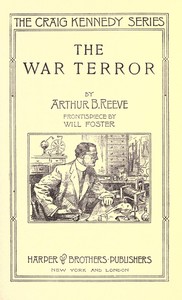
I remember first meeting Professor Kennedy in the pages of The Treasure-Train, that mix of train clocks and early lab work leaving a quiet ache for a New York that has slipped away. The gold plot felt urgent then. Now, returning to his world through The War Terror — Context and Discussion, I find the same eerie patience, the way his science once seemed so modern, and now feels almost like a dream.
Answer a few questions and save a private reflection on this device.