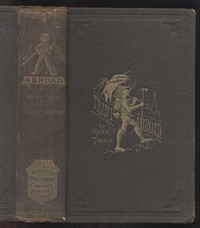
About 117 minutes
A Tramp Abroad — Volume 06 — Background and Themes
Technology Airships Imagined Futures
26,774 recorded words. 0 minutes difference from this book's estimate.
View Gutenberg source #5787
For The Inside of the Cup — Volume 05 — Text and Context, the stored edition analysis reports 26,783 words, 1 hr 57 min estimated reading time, and 3 detected text sections.
The text analysis averages about 16.0 words per sentence, while the detected sections provide another way to judge how the source is divided.
Project Gutenberg metadata also associates the work with “Christian life -- Fiction,” connecting these edition facts with the source record’s subject description.
Explore this collection
These alternatives are selected using recorded categories and estimated reading time.
About 117 minutes
Technology Airships Imagined Futures
26,774 recorded words. 0 minutes difference from this book's estimate.
View Gutenberg source #5787About 110 minutes
Technology Airships Imagined Futures
25,266 recorded words. 7 minutes difference from this book's estimate.
View Gutenberg source #5359About 110 minutes
Technology Airships Imagined Futures
25,243 recorded words. 7 minutes difference from this book's estimate.
View Gutenberg source #7891Search stored excerpts and compare books → Choose by your preferences →
Choices use stored catalog measurements. Estimates vary with reading speed. A shared category is a catalog label, not a claim that two books have the same argument or literary quality.
Search reads excerpt text stored with this catalog and links to its associated Gutenberg record. The connection is stored in the site database; this tool does not recheck that every excerpt is word-for-word identical to that external record. Excerpt search does not cover every chapter and does not verify historical publication dates.
Catalog snapshot checked: 2026-09-25. Coverage: 95 public books, 95 available source excerpts.
Read the complete public-domain text at its original source.
Read on Project GutenbergThe fifth volume of Winston Churchill's The Inside of the Cup opens with rector John Hodder confronting a series of paradoxes. Having entered a restaurant of ill repute and ordered champagne for a woman he knows as Kate Marcy, he awakens without a sense of sin—a state that challenges his orthodox theology. The narrative immediately establishes a pattern of movement between interior reflection and external action, as Hodder's thoughts shift from the specific event to broader questions of evil, despair, and meaning. The text uses recurring images of sight and blindness: Hodder had previously viewed the universe through “coloured glasses of an outworn theology,” but now he has “flung off his spectacles” and plunged into reality. This visual motif recurs throughout the volume, underscoring a central concern with perception and revelation.
The volume's structure mirrors Hodder's fragmented state of mind. The opening chapter, “Reconstruction,” begins with the word “Life” and immediately introduces a series of contradictions: he is a clergyman who has broken social codes, yet feels no guilt; he has fallen under the influence of the “tempter,” yet this fall enables a new friendship. The narrative moves rapidly between past and present, contrasting his former orderly life in Bremerton with the chaotic reality of Dalton Street. The text describes his past as “the highroad of a fancied security,” while his present is a “plunge into reality” that leaves him “scratched and battered.” This structural oscillation—between memory and immediate experience, between theological certainty and doubt—creates a rhythm that reinforces the theme of disorientation. The chapter titles themselves suggest a progression from reconstruction to causation to partisanship, but the actual narrative resists linear development, instead circling back to core questions.
Throughout the excerpts, Churchill employs a cluster of related images that give the volume a cohesive texture. The motif of sight appears repeatedly: Hodder speaks of “the scales fallen from his eyes,” and later describes his former theology as “coloured glasses.” The act of seeing is linked to understanding, and blindness to illusion. Another recurring image is that of chaos versus order. Hodder reflects that he had once seen “the illusion of an orderly world,” but now he sees “the evil, the injustice, the despair.” The word “chaos” appears explicitly, and the narrative uses spatial metaphors—highroad, peaks, depths—to map his spiritual journey. Transformation is figured as a chemical or physical process: sorrow is “transmuted, as by a chemical process,” and later, Paul's conversion is described as being “made incandescent.” These images work together to suggest that change is not a simple moral decision but a fundamental alteration of perception and being.
The volume's second major movement is a sustained theological dialogue, likely between Hodder and Kate Marcy. The excerpts show Hodder explaining concepts such as the Atonement, the descent into hell, and the subconscious self. He reinterprets traditional doctrines: “Atonement may be pronounced At-one-ment,” he says, and the descent into hell is explained as a historical controversy about Christ's death. The dialogue is marked by a careful back-and-forth, with Kate posing pointed questions—“And the Atonement? doesn't that imply a sacrifice of propitiation?”—and Hodder responding with a blend of modern psychology and liberal theology. The structure of the conversation mirrors the volume's larger pattern: it moves from specific doubts to broader principles, and from abstract ideas to personal application. The text notes that Kate listens “motionless, as under the spell of his words,” yet also possesses an “indomitable spirit of resistance.” This tension between persuasion and resistance gives the dialogue its dramatic force.
A key concept introduced in the theological discussion is the theory of the subconscious self. Hodder explains that every person has a conscious, “lower” self and a subconscious, “better” self that “stretches down into the depths of the universe and taps the source of spiritual power.” This idea serves as a bridge between psychology and theology, offering a framework for understanding grace, rebirth, and the union of the human and divine. The language is notably physical: the subconscious “stretches down,” and the conscious self must “reach out by an effort of the will.” The resulting union is described as “the incarnation of the Spirit in the conscious,” and the higher self “takes the reins.” This mechanistic yet mystical language reflects the volume's attempt to reconcile modern thought with traditional faith. The concept also echoes the earlier image of Hodder plunging into reality—now reinterpreted as a descent into the subconscious that leads to spiritual connection.
Readers attentive to the volume's structure will notice how Churchill uses movement between scenes—from Hodder's solitary reflections to intense dialogue—to dramatize the process of intellectual and spiritual change. The recurring images of sight, chaos, and transformation are not decorative but structural, shaping the narrative's arc. This volume does not resolve the questions it raises; instead, it deepens them, inviting the reader to follow Hodder's path from certainty to a more complex, tentative faith.
There’s a particular ache in watching Hodder try to hold his faith together after that night, the way sight and chaos blur into each other. It reminds me of the quieter unease I found in The Dead Alive — Reading Notes, where even stillness felt fragile. Some books just leave that residue, don’t they?
A brief reflection can help important ideas stay with you longer.