About 209 minutes
The Gold Bat — Story, Setting & Ideas
Young Readers Enchanted Adventures
48,051 recorded words. 17 minutes difference from this book's estimate.
View Gutenberg source #6879
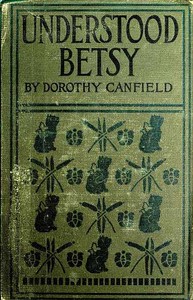
This digital edition of Understood Betsy — Context and Discussion is described by source-level measurements including 51,883 words, 3 hr 46 min estimated reading time, and 14 detected text sections.
The text analysis averages about 17.1 words per sentence, while the detected sections provide another way to judge how the source is divided.
Project Gutenberg metadata also associates the work with “Orphans -- Juvenile fiction,” connecting these edition facts with the source record’s subject description.
Explore this collection
These alternatives are selected using recorded categories and estimated reading time.
About 209 minutes
Young Readers Enchanted Adventures
48,051 recorded words. 17 minutes difference from this book's estimate.
View Gutenberg source #6879About 256 minutes
Young Readers Enchanted Adventures
58,673 recorded words. 30 minutes difference from this book's estimate.
View Gutenberg source #5003About 181 minutes
Young Readers Enchanted Adventures
41,526 recorded words. 45 minutes difference from this book's estimate.
View Gutenberg source #8394Search stored excerpts and compare books → Choose by your preferences →
Choices use stored catalog measurements. Estimates vary with reading speed. A shared category is a catalog label, not a claim that two books have the same argument or literary quality.
Search reads excerpt text stored with this catalog and links to its associated Gutenberg record. The connection is stored in the site database; this tool does not recheck that every excerpt is word-for-word identical to that external record. Excerpt search does not cover every chapter and does not verify historical publication dates.
Catalog snapshot checked: 2026-09-25. Coverage: 95 public books, 95 available source excerpts.
Read the complete public-domain text at its original source.
Read on Project GutenbergFrom its first chapter, Understood Betsy establishes a narrator who is both wryly observant and willing to poke fun at its own characters. The opening describes Elizabeth Ann's household—Aunt Harriet, Aunt Frances, and Grace the maid—as all “very small and thin,” despite having “plenty to eat,” and the narrator wonders aloud, “I wonder what was the matter with them?” This playful, slightly ironic tone sets the stage for a story that will gently challenge the protective, anxious world Elizabeth Ann inhabits.
The excerpts reveal a child who is initially defined by her failures: she “had failed in her examination” and feels a “lump in her throat.” Yet the narrative quickly moves her to a Vermont sugaring-off scene, where sensory details—the “tarry perfume of the big pine-tree,” the “icy and wet” snow, the dog Shep with candy “draped in melting festoons”—pull her into a different kind of knowing, one that has little to do with school grades.
The narrator of Understood Betsy does not simply report events; it comments, questions, and occasionally teases the reader. In the opening chapter, after listing the household’s physical frailties, it inserts: “And yet they all had plenty to eat. I wonder what was the matter with them?” This direct address invites readers to consider the gap between material care and emotional or physical well-being. Later, when Elizabeth Ann fails her examination and Cousin Ann tells her that “Hemlock Mountain will stand right there just the same even if you did forget to put a b in ‘doubt,’” the narrator steps in to note that “it’s my opinion that she had made a very good beginning of an understanding.” The narrator thus acts as a guide, gently steering interpretation without dictating it.
The excerpts center on a school examination that Elizabeth Ann fails, but the text is less interested in the test itself than in the emotional and philosophical fallout. The girl is “in a daze” after Cousin Ann’s remark, and the narrative follows her outside into a landscape that offers an alternative form of assessment. The syrup-waxing scene is rich with concrete actions—pouring syrup on snow, lifting a “great coil,” crunching it with “strong, child’s teeth”—that contrast with the abstract anxiety of the examination. The dog Shep’s greedy, messy enjoyment of the candy further underscores a world of immediate, physical pleasures. The mountain, “all blue and silver with shadows and snow,” becomes a silent rebuke to the notion that a spelling mistake matters much. The narrator’s final comment suggests that understanding, for Betsy, will come not from passing tests but from engaging with the world around her.
Fisher’s prose is notably attentive to sensory experience, and the excerpts use this to mark Betsy’s shifting state of mind. Early descriptions of the city household are vague and generic—a “medium-sized city in a medium-sized State”—but the Vermont scenes are specific and vivid. The sap “dripped musically into a bucket,” the blue-jay’s “screaming and chattering” sounds like “noisy children at play,” and the candy is “concentrated sweetness of summer days.” These details do more than set a scene; they signal a world that demands attention and rewards it. Betsy’s absorption in the sugaring-off—her focus on the mountain, the dog, the taste—gradually replaces her earlier anxiety. The text suggests that such embodied experiences are a form of learning as valid as any classroom lesson. The mountain, which “loomed up bigger and bigger as though it reached to the sky,” becomes a measure of something vast and enduring, against which a failed examination shrinks to its proper size.
Readers coming to Understood Betsy will find a story that resists easy moralizing. The excerpts hint at a longer arc in which Elizabeth Ann becomes Betsy, but the novel’s pleasures lie in its moment-by-moment observations: the taste of waxed sugar, the weight of a mountain in dusk, the narrator’s dry asides. Pay attention to what the text chooses to describe in detail and what it skips over; those choices reveal where the story’s true interests lie.
Sometimes a book lingers like the smell of boiling sap, and Understood Betsy leaves that sweetness. Watching Elizabeth Ann find her footing reminds me how often a person needs quiet space to become themselves. I find that same tender patience in the old pages of Patty's Suitors — Reading Companion, where affection grows slowly, like a friendship worth keeping. A gentle kinship, indeed.
Your answers remain private and are stored only in this browser.