About 564 minutes
The Yeoman Adventurer — Context and Discussion
Sea Voyages Pirate Adventures
129,707 recorded words. 40 minutes difference from this book's estimate.
View Gutenberg source #7326
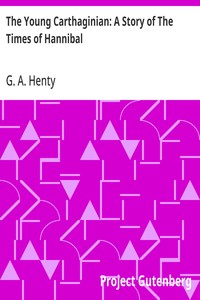
For The Young Carthaginian: A Story of The Times of Hannibal — A Closer Reading, the stored edition analysis reports 120,456 words, 8 hr 44 min estimated reading time, and 12 detected text sections.
The text analysis averages about 24.3 words per sentence, while the detected sections provide another way to judge how the source is divided.
Project Gutenberg metadata also associates the work with “Carthage (Extinct city) -- History -- Fiction,” connecting these edition facts with the source record’s subject description.
Explore this collection
These alternatives are selected using recorded categories and estimated reading time.
About 564 minutes
Sea Voyages Pirate Adventures
129,707 recorded words. 40 minutes difference from this book's estimate.
View Gutenberg source #7326About 428 minutes
Sea Voyages Pirate Adventures
98,303 recorded words. 96 minutes difference from this book's estimate.
View Gutenberg source #8446About 391 minutes
Sea Voyages Pirate Adventures
89,703 recorded words. 133 minutes difference from this book's estimate.
View Gutenberg source #4680Search stored excerpts and compare books → Choose by your preferences →
Choices use stored catalog measurements. Estimates vary with reading speed. A shared category is a catalog label, not a claim that two books have the same argument or literary quality.
Search reads excerpt text stored with this catalog and links to its associated Gutenberg record. The connection is stored in the site database; this tool does not recheck that every excerpt is word-for-word identical to that external record. Excerpt search does not cover every chapter and does not verify historical publication dates.
Catalog snapshot checked: 2026-09-25. Coverage: 95 public books, 95 available source excerpts.
Read the complete public-domain text at its original source.
Read on Project GutenbergG. A. Henty opens his preface with a direct address to 'my dear lads,' establishing a conversational, instructive tone that frames the novel as both entertainment and education. He admits that as a schoolboy he sympathized with the Carthaginians 'generally with the unfortunate,' a remark that reveals his authorial stance: the story will champion the underdog. Henty then cites his historical sources—Polybius, Livy, and M. Hennebert—asserting that Polybius' descriptions are 'far more accurate' because he visited the Alpine passes and spoke with witnesses. This explicit reliance on scholarship signals that the narrative will weave documented events with fictional adventure.
Henty’s preface does more than introduce; it establishes a pact. He confesses that schoolboys of his day had only a 'hazy idea' of the Punic Wars, knowing little beyond Hannibal’s victories and Rome’s eventual cruelty. By admitting this gap, he positions his book as a remedy. The phrase 'I think that most of you would also like to know a great deal more' directly invites the reader into a shared curiosity. This is not a dry history lesson but a story built on 'authentic material,' as he calls it. The preface’s informal, confiding voice—'When I was a boy at school'—contrasts with the formal catalog subjects, hinting that the novel will balance scholarly detail with youthful energy.
In the excerpt describing Hannibal’s passage through the Alps, Henty’s diction emphasizes chaos and physical strain. Words like 'dismay,' 'confusion,' 'snorting with fright,' and 'piercing yells' create a sensory assault. The horses 'plunged and struggled wildly,' while men 'lost their footing, and rolling down were dashed to pieces.' The repetition of 'confusion' and 'dismay' reinforces the army’s vulnerability. Henty avoids glorifying the struggle; instead, he dwells on the 'terrible' disorder. The mountaineers are not faceless foes—they 'send up the most piercing yells' and roll rocks, their tactics described with tactical precision. This passage shows Henty’s preference for concrete, physical language over abstract heroism.
Dialogue in the excerpt is sparse but functional. Malchus’s command to his Arabs—'Come, my men, where these men can climb we can follow them'—is the only direct speech. It serves as a turning point, transforming the column’s paralysis into action. The line is terse, urgent, and devoid of ornament, reflecting Henty’s tendency to use dialogue to advance plot rather than reveal character. Earlier, the Gauls 'entered freely into conversation' with the mountaineers, but their words are summarized, not quoted. This asymmetry suggests that Henty values the strategic content of speech over its dramatic texture. The result is a narrative where dialogue feels like a tool of military command, not personal expression.
The Alpine crossing is structured as a classic Henty set piece: a problem (the pass blocked), a reconnaissance (Malchus and the Gauls), a clever stratagem (feigning a halt), a sudden reversal (the natives attack at dawn), and a desperate solution (scaling the cliffs). This pattern recurs throughout the novel—see chapter titles like 'A Night Attack' and 'The Siege of Saguntum.' Henty builds tension through layered details: the 'lateral ravines,' the 'narrow ledge,' the 'carts' falling. He also uses the landscape as an antagonist, describing precipices as 'absolutely inaccessible' and paths so narrow horses can barely proceed. The structure mirrors a military report, with clear cause and effect, but the vivid sensory details—'strange wild cries, echoed and re-echoed a score of times'—lift it above mere documentation.
Readers attentive to Henty’s craft will notice how he balances historical fidelity with narrative momentum. The preface’s scholarly citations are not mere decoration; they underpin the novel’s claim to authenticity. Yet the prose never bogs down in pedantry—action scenes move swiftly, driven by physical detail and strategic logic. For those interested in how Victorian adventure fiction handled ancient history, this book offers a clear example of a writer who trusted his young audience to appreciate both a good story and a well-researched one.
There’s a particular quietness in Henty’s preface—that careful, almost parental weighing of what to tell and what to spare—which stays with me long after I close the book. It reminded me, strangely, of the unhurried solitude I found in The Solitary Summer — Reading Companion. Both share a private, deliberate pacing; a sense of someone thinking softly on paper, without needing applause.
Build a private reading journal entry for this title.