About 294 minutes
Black Caesar's Clan : A Florida Mystery Story — Context and Discussion
Sea Voyages Pirate Adventures
67,517 recorded words. 31 minutes difference from this book's estimate.
View Gutenberg source #4789
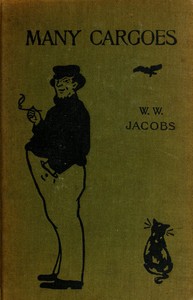
Many cargoes — Themes and Context can be approached with a clearer sense of reading commitment from its source measurements: 74,734 words, 5 hr 25 min estimated reading time, and 23 detected text sections.
The text analysis averages about 15.6 words per sentence, while the detected sections provide another way to judge how the source is divided.
Project Gutenberg metadata also associates the work with “Humorous stories, English,” connecting these edition facts with the source record’s subject description.
Explore this collection
These alternatives are selected using recorded categories and estimated reading time.
About 294 minutes
Sea Voyages Pirate Adventures
67,517 recorded words. 31 minutes difference from this book's estimate.
View Gutenberg source #4789About 373 minutes
Sea Voyages Pirate Adventures
85,740 recorded words. 48 minutes difference from this book's estimate.
View Gutenberg source #6987About 391 minutes
Sea Voyages Pirate Adventures
89,703 recorded words. 66 minutes difference from this book's estimate.
View Gutenberg source #4680Search stored excerpts and compare books → Choose by your preferences →
Choices use stored catalog measurements. Estimates vary with reading speed. A shared category is a catalog label, not a claim that two books have the same argument or literary quality.
Search reads excerpt text stored with this catalog and links to its associated Gutenberg record. The connection is stored in the site database; this tool does not recheck that every excerpt is word-for-word identical to that external record. Excerpt search does not cover every chapter and does not verify historical publication dates.
Catalog snapshot checked: 2026-09-25. Coverage: 95 public books, 95 available source excerpts.
Read the complete public-domain text at its original source.
Read on Project GutenbergW. W. Jacobs's Many Cargoes (1894) is a collection of twenty-three stories set largely among the wharves and vessels of the Thames and the English coast. The book opens with a night-watchman as a framing narrator, whose colloquial, digressive voice—punctuated by sudden chuckles and asides—establishes a tone of wry, understated humour. The stories themselves vary widely in pace and mood, from farcical misunderstandings to grimly ironic outcomes, often hinging on a single, absurd premise.
The night-watchman who introduces the first story, “A Change of Treatment,” speaks in a rambling, anecdotal style: “Yes, I’ve sailed under some ’cute skippers in my time,” he begins, then adds a “sudden chuckle.” This framing device gives the collection a conversational intimacy, but Jacobs does not sustain it uniformly. In later stories such as “After the Inquest,” the narrative shifts to a more detached third-person perspective, describing a “still fair evening in late summer” with a quiet, observational precision. The effect is a deliberate variation in narrative distance—sometimes the reader is confided in by a garrulous old salt, sometimes left to observe scenes from a cool, almost reportorial distance.
Many stories pivot on a single, often grotesque, comic idea. In “A Change of Treatment,” a skipper’s obsession with medicine leads a sailor to feign heart disease by memorising symptoms from a book: “That’s how I feel,” he says, “Just strength enough to get to bed.” The humour derives from the exaggerated performance and the skipper’s gullibility. Yet Jacobs undercuts the comedy with a darker edge: the same story mentions a near-mutiny over a post-mortem, and the skipper’s fad is described as “unwholesome.” In “After the Inquest,” a man presumed dead returns to find his funeral already held, his headstone reading “Not lost, but gone before.” The mate’s deadpan delivery—“That’s the worst of not being used to it”—turns a macabre situation into grim farce, but the underlying unease lingers.
Jacobs controls pace largely through dialogue and the accumulation of concrete, often mundane details. In “After the Inquest,” the mate’s slow, deliberate speech—“The news … is that you was found last Tuesday week off St. Katherine’s Stairs”—stretches out the revelation, while the returned man’s impatient interjections (“Buried? … You’ve been drinking, George”) create a staccato rhythm. Elsewhere, the night-watchman’s digressions—such as his aside about “them that go down in big ships see the wonders o’ the deep”—slow the narrative, mimicking oral storytelling. Jacobs also uses physical description to anchor scenes: the mate’s pipe “fell from it and smashed to pieces unnoticed” is a small, telling detail that signals shock without explicit statement. These shifts in tempo—from leisurely anecdote to clipped, tense exchange—give the collection a varied, unpredictable rhythm.
Readers approaching Many Cargoes will find a collection that rewards attention to its narrative frames and tonal shifts. The stories are best read as individual set-pieces rather than a continuous arc; the humour often depends on the reader’s willingness to accept absurd premises and deadpan delivery. Pay particular attention to how Jacobs uses the night-watchman’s voice to establish expectations that later stories quietly subvert.
I keep thinking about that old night-watchman’s voice—how easily it drifts from a chuckle to something colder, the river right there underneath. It reminded me of the quieter pieces in Other Tales and Sketches (From: "The Doliver Romance and Other Pieces: Tales and Sketches") — A Closer Reading, where the ordinary slowly turns, and you’re just left holding the feeling after the page turns.
Create a short personal record of your experience with this book.