
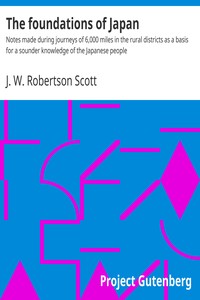
The foundations of Japan : Notes made during journeys of 6,000 miles in the…
Published in 1922, 'The Foundations of Japan' is not a novel with a plot, but a journey with a purpose. Scottish journalist J.W. Robertson Scott arrived in Japan during the Taisho era, a brief period of political liberalism and social change sandwiched between the militarism of the Meiji Restoration and the rise of 1930s nationalism. His goal was simple: to go beyond Tokyo and Kyoto and see how the vast majority of Japanese people—the rural population—were actually living.
The Story
The 'story' is his adventure. For months, he traveled by train, rickshaw, and on foot, covering over 6,000 miles. He visited remote farming villages, small towns, and coastal communities. Instead of seeking out famous sights, he sought out conversations. He sat with farmers in their fields, drank tea with local mayors, visited schools, and asked women about their daily lives. He meticulously recorded what he saw: the state of agriculture, the challenges of poverty, the impact of new laws, and the quiet persistence of old customs. The book is built from these hundreds of small encounters, creating a mosaic of a nation in the middle of a profound, and often difficult, transformation.
Why You Should Read It
What makes this book special is its grounded, human perspective. Robertson Scott isn't a romantic or a philosopher; he's a reporter. He's curious, sometimes skeptical, and always respectful. Because of this, he captures a Japan rarely seen in Western accounts of the time. You get the sense of ordinary people grappling with soaring land prices, new educational systems, and shifting social roles. You feel the tension between a deep reverence for the past and an anxious pull toward the future. Reading it today, it’s startling how familiar some of these struggles feel—the conversations about rural decline, economic pressure, and cultural identity could be pulled from a modern newspaper. It connects the dots between the Japan of a century ago and the Japan we know now in a way few books do.
Final Verdict
This book is a perfect fit for anyone who loves immersive travel writing, social history, or has a deep interest in Japan. If you've enjoyed modern books like Hokkaido Highway Blues or Bicycle Diaries and want to see a historical version of that deep-dive exploration, you'll love this. It’s also fantastic for readers who think history is boring; Robertson Scott makes it feel immediate and personal. Be prepared for a slow, observational read—it’s a thoughtful walk, not a thrilling sprint. But if you let it, it will transport you completely to the dusty roads and quiet homes of a Japan that was busy laying the groundwork for everything that was to come.
The copyright for this book has expired, making it public property. Knowledge should be free and accessible.
Robert Gonzalez
11 months agoI have to admit, the content flows smoothly from one chapter to the next. Exceeded all my expectations.







Sarah Lopez
1 year agoHonestly, the depth of research presented here is truly commendable. I would gladly recommend this title.