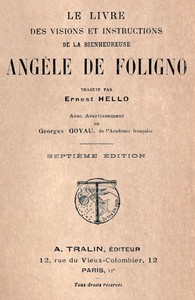
Le livre des visions et instructions de la bienheureuse Angèle de Foligno by Angela
This isn't a novel with a plot in the usual sense. It's a spiritual autobiography and a set of teachings dictated by Angela to her confused but faithful cousin and scribe, Brother Arnaldo. The 'story' is the journey of her soul.
The Story
Angela starts as 'Sister Angela,' a married woman of means living a worldly life in Foligno, Italy. After a series of devastating personal losses, she prays for a deeper understanding of suffering. What she gets is an overwhelming, non-stop series of visions and encounters with the divine that completely unmake her. She describes these experiences with shocking physicality—unspeakable joy, crushing grief, and a sense of being literally consumed by love. Brother Arnalgo often interrupts the text to say things like, 'I don't fully understand what she means here,' which makes her account feel even more immediate and real. The book follows her through these stages, culminating in her 'Instructions'—practical, fiery advice on how to live a truly spiritual life, born from her extreme experience.
Why You Should Read It
Forget the dry, stained-glass image of a saint. Angela is fierce, emotional, and deeply human. Her writing burns with a need to communicate something she admits is nearly impossible to put into words. This isn't about dogma; it's about the raw, messy, and overwhelming experience of the sacred. Reading her feels like listening to a friend describe the most profound moment of their life, stumbling and searching for the right phrases. It challenges the quiet, polite spirituality we often imagine. Her God is not a distant idea but a presence so intense it's almost violent in its love.
Final Verdict
This is not a light read, but it's a stunning one. It's perfect for readers curious about mysticism, medieval history, or powerful first-person accounts of transformation. If you liked the visceral honesty of Teresa of Ávila or the psychological depth in modern spiritual memoirs, you'll find Angela a fascinating, centuries-old kindred spirit. Approach it not as a theological textbook, but as one woman's unforgettable, earth-shaking testimony.
This historical work is free of copyright protections. Thank you for supporting open literature.